


Avebury: Landscape, Psyche, and the Presence of the Past

Introduction
In late March I took an impromptu trip to Avebury in the English county of Wiltshire. My first experience of this special place came a few years ago when travelling from Swindon to Devizes to see an Eric Ravilious exhibition. This was a new land to me, and I had no real knowledge of the locality. So when the trundling bus, making its way down a small B road, was suddenly in between huge standing stones only a few feet away, I was taken aback and fascinated by this sudden appearance of the deep past. The shock of the old!
In the time since this initial encounter I had read about the area numerous times, but on the day I decided to make the journey I had done no specific research or planning. I thought that it was likely I would miss key details or significant places, but sometimes it is good to be guided by nothing other than where one’s feet feel like treading, and where they do not. So this isn’t an attempt to describe the full history and purpose of this ritual landscape, but to convey something about my experience of meeting it.
Swindon and the contemporary landscape
My journey to Avebury (first by train from Newport, then on the bus) included an unscheduled hour in Swindon, for which I am blaming a signpost malfunction. With all due respect to the fine folk of this town, it was an hour of my life I would dearly like to claim back. I wandered about in what seemed to be the commercial centre, and as it was quite early on a Saturday not everywhere was open, yet it had about it the sense of a civilisation that was never really going to be fully ‘open for business’ ever again, and that, of course, is by no means unique to Swindon.
However, there is an aptness to this, as any self-respecting modern antiquarian heading out for a weird walk will understand: our relationship to the past is to a large extent influenced by the current culture in which one dwells (in my case what could be referred to as ‘dominant Western’, to recognise this is not the only culture available). This commercial area felt strangely ritualised in its layout and anticipated modes of interaction and exchange, monolithic in its banality. In the end I accepted my fate along with a bowl of coffee which managed to be both simultaneously weak and strikingly bitter. Perhaps that in itself captures something of the prominent characteristics of such a culture's fading days.
Place, psyche, and orientation
Now I think about it, in contrast to my experience of Swindon, despite also having no awareness of the geography of Avebury and its surroundings, far from wandering about feeling lost, there was instead a definite sense of knowing exactly where to go the moment I left the bus. Maybe that is what defines much of the urban landscapes we have constructed (and continue to build); they feel like nowhere. One can be simultaneously surrounded by buildings and people, yet utterly dislocated, which at least in my own experience can sometimes be mildly dissociative.
In addition to experiencing the physicality of place, I think this also has to do with what we can describe as the ‘non-local psyche’, which to illustrate in James Hillman’s terms means that psyche is not only something I experience as being within me, but that I am within psyche.
Places have distinct energies, characters, spirits, their own beingness. To continue with Hillman’s perceptive mode of ‘seeing with the pathological eye’, he would insist that we locate the ‘problem’ less within the individual and more within the world. This would mean that rather than my dissociative tendency being placed ‘on the couch’ for introspection, we instead analyse and interpret what might be pathological about how the buildings and localities we inhabit are designed and constructed. Starting with why are they designed as they are, and then broadening this out to enquire about why humanity even has within it the capacity to create environments that can seem so apart from Nature, despite ourselves being part of Nature.

Encountering the stones and psyche of the Avebury landscape
I digress, back to the old stones.
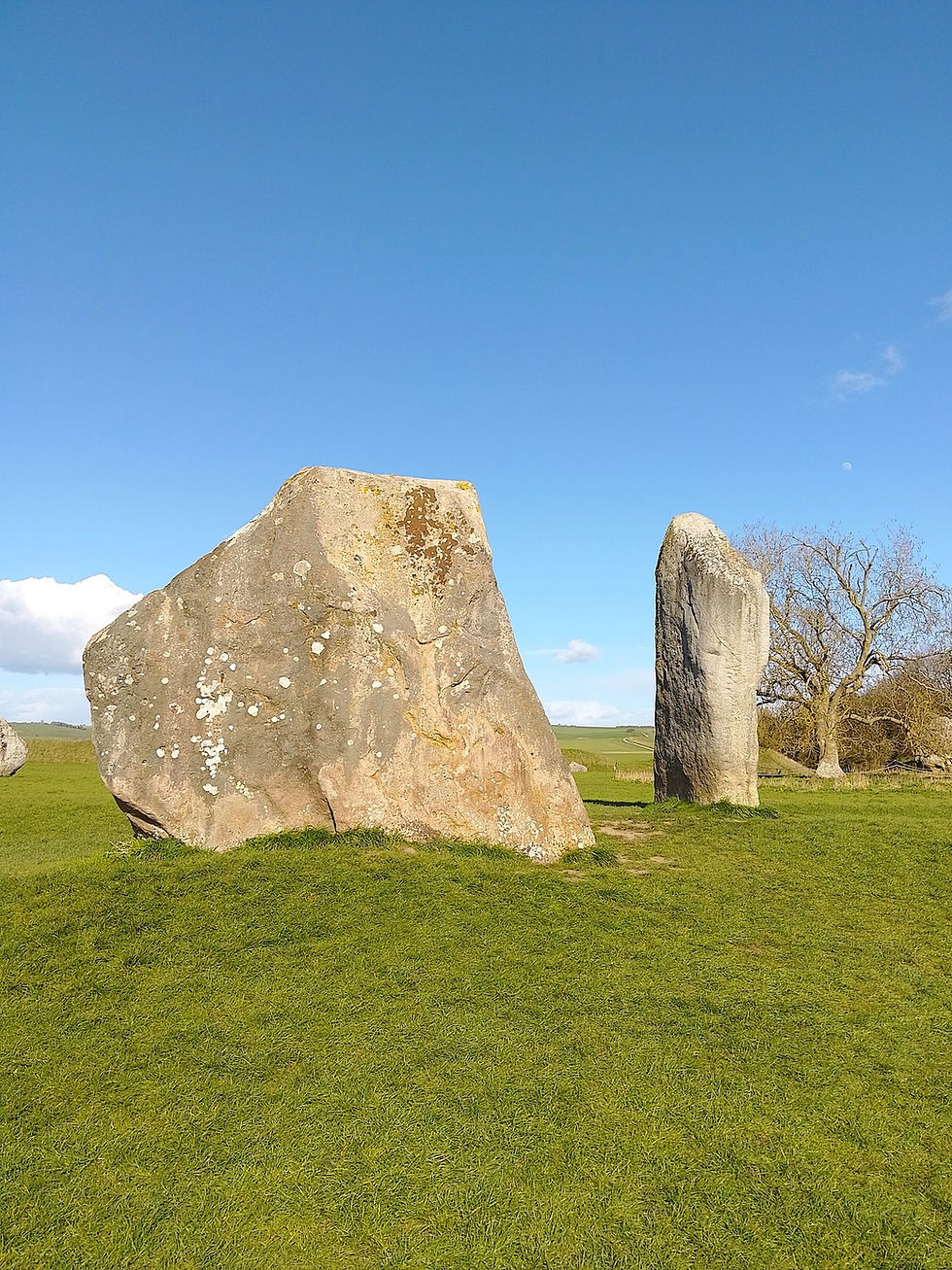
According to my sources, Avebury is either home to the largest stone circle in Europe, or the world. Either way, originally containing over 100 stones, it is of sufficient size to encompass a village with pub, manor house, and church. Many of the stones were damaged or removed at times when the pagan lore of the site was out of favour with pious locals.
Arriving in the village, the stones are immediately present. It was a bright and breezy spring day, and few people were around when I arrived. I wandered out into the field next to the bus stop, and up to some of the largest of the megaliths. It is no wonder that in recent years there has been such an upswell of interest in sites such as this, and it is baffling how their powerful presence could go unnoticed or unrespected by successive generations. Religious authority will have played a large part, but even so, surely there were always those who held the significance of the ancients within their hearts.

The Ridgeway and the wider landscape
As is usually my way, I felt called to the hills and the wider landscape, so after just a brief foray through the first field of stones I headed east along a path which took me up to The Ridgeway. Known as ‘Britain’s oldest road’, this 87-mile-long path travels along a ridge of chalk, linking Avebury with Ivinghoe Beacon in Buckinghamshire, its origins dating back to the Neolithic.
The area is Fyfield Down, which is noted for its Grey Wethers, hundreds of stones scattered amongst the landscape, the raw material for Avebury and Stonehenge, so named because they look like grey sheep grazing. This is a great place from which to get a sense of the ritual complex as a whole. I could hear (but not see) a goshawk in the woods behind me, as I looked out towards a vista of gently rolling green downland.

Silbury Hill and the sense of presence
Setting off in the direction that simply felt like the way to wander, I felt invigorated by the breeze and brightness, emergent after a long wet winter. Whilst my journey didn’t take me to West Kennet Long Barrow (a key feature, for which I shall have to return), I did walk past a number of tumuli which were wooded, and about them an uncanny atmosphere, out of the way, somewhat forgotten in favour of their more renowned neighbours. The round barrows I found are part of a Bronze Age cemetery.

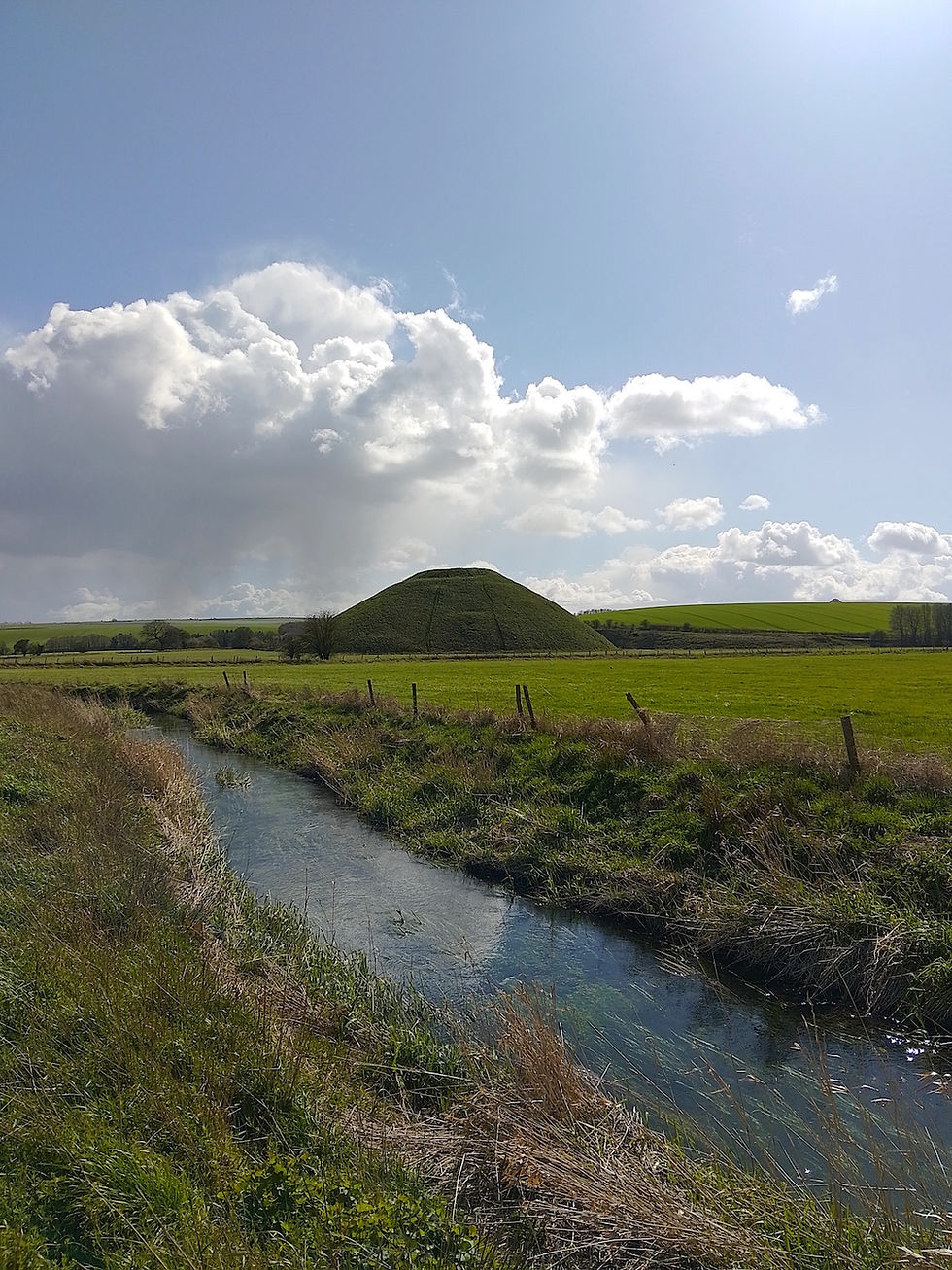
I knew that Silbury Hill is situated to the south of Avebury, so I headed in that direction, surprised by how concealed it is within the landscape. As I moved in search of its blancmange-like form, my path took me to West Kennet Avenue. This is a procession of standing stones which would originally have stretched one and a quarter miles from Avebury to a timber and wood circle known as The Sanctuary. Archaeologists have not been able to locate the middle section, but the stretch from Avebury is truly special.

Continuing up the hill towards the west, still unsure of where Silbury was, I had a momentary sense of approaching summer as the sun shone warmly despite the persistent wind, and the rich greens of the grass shimmered as though liquid. Then it was before me, an arresting vision, and truly one of the most remarkable sights I have beheld. Not that I had anything particular in mind about this place prior to seeing it, but I was genuinely taken aback by the power of the place.

Its original purpose remains mysterious, but at around 40 metres high it is the largest artificial mound in Europe. Originally it would have been white, as it is constructed from chalk, which must have made it an incredibly vibrant sight, entirely distinguished from the verdant surroundings. Also one which must have seemed otherworldly, given its uniqueness. Recent surveys have unearthed evidence suggesting that it could have been constructed over a period of some 200 years.

Returning to Avebury
I could have got a little closer to the mound, but that would have involved getting nearer to the car park and road, so instead I moved along to some blackthorn, before heading north towards Avebury alongside the River Kennet, which flowed gentle and clear.


On reaching the village I had a look around the churchyard, before having a rest at the Red Lion. Very rare is a pub where one can drink an ale in view of ancient stones.
Soaking up the sun, I decided to make the most of it and refill my glass. Emerging from the pub after a couple of minutes, I found people scrambling to put up the sun shades, which were now needed for the hail that was pouring down, annihilating the book I had left on the table. This brings to mind being within psyche, and the landscape of Avebury is certainly a place which feels immersive.

With the squall receding, the moon rose in the still bright sky, so I made my way around more of the central area. Busy with visitors for most of the day, there were fewer people now, and with the light beginning to fade there was a tangible shift in energy, as though the stones were returning to an ancient time.
And I also returned, to Newport, via Swindon.


Sources
Hidden Histories – A Spotter’s Guide to the British Landscape
Magical Britain – 650 Enchanted Sites
Weird Walk – Wanderings and Wonderings through the British Ritual Year
Andrew Phillips is a Visual Artist, Psychotherapist, and Creative Mentor in the UK.
In my paintings and drawings I explore landscape as an expression of the Numinous, and you can see these images in the website gallery. Original artworks are available to buy from the shop.
Themes of landscape, place, and psyche are also significant in my work with individuals as a psychotherapist, and I offer online session in the UK. On the website you can also find details of Creative Mentoring for artists, in which these areas can also be explored in relation to your own art practice. If you would like to make an enquiry about working together you can get in touch using the contact details at the foot of any page.
Numinous Landscape is a regular newsletter in which I write about art, Nature, spirituality, and depth psychology. If you would like to subscribe please visit the form at the foot of any page on the website.


