


British Landscapes: A Sense of Place at Pallant House Gallery
Updated: 3 days ago

Always a place I love to visit, British Landscapes: A Sense of Place at Pallant House Gallery brings together work by artists who regard landscape in a variety of ways, but always as more than mere scenery. In this article I explore several artists with whom I feel a particular connection through my own experience of landscape, making art, and being in the world.

Landscape as presence
Paul Nash

Upon arriving at the exhibition rooms, Avebury – Landscape of the Megaliths by Paul Nash is among the first works to greet the visitor. In a similar way to how the ritual landscape of Avebury invites one into a world that feels entirely natural and vitalised, yet somehow outside the mundane, perhaps the exhibition as a whole begins to establish its own sense of sacred space.
Around Avebury are stone circles, long barrows, burial mounds, the entrancing Silbury Hill and the ancient Ridgeway track. There is also a road cutting straight through the site, along with a pub, shops, a visitor centre and houses. The sacred and ordinary coexist.
Within the exhibition we encounter work serving very different purposes, offering initiations into the British landscape in many guises: remote vastness, human-scale fields, intimate worlds hidden within the thicket, and the meeting of town and country.
Samuel Palmer

I first encountered the work of Samuel Palmer when I was living in Kent, not too far from his beloved Shoreham, which I was able to visit on a couple of occasions. He referred to this area as his Valley of Vision, and in the work inspired by it he evokes a rare magic.
Palmer did not begin etching until 1850, around fifteen years after his renowned Shoreham period. The Rising Moon, and many other later works, combine memories of Shoreham with impressions of places he encountered elsewhere, including Devon and Italy. I really like this way of allowing powerful experiences of the places he loved to remain alive within him, before being conjured later into entirely new forms.
Sometimes described as “visionary pastoral”, I experience many of his works as having a profoundly spiritual quality that is not so easily defined. There is a richness and depth that seems to have come straight from the hedgerow, inviting one to enter and know the image from inside. In painting, Palmer often worked through layers of glaze, which only deepens this sense of worlds within worlds.
In this related post I have written about Ithel Colquhoun, another British artist with an intense lived and embodied relationship to particular places.
Graham Sutherland

Presented in the same room as Palmer’s etching is a tiny watercolour by Graham Sutherland, titled Clapham Church and measuring just under 10cm square. Sutherland was associated with the pastoral etching revival of the 1920s and expressed admiration for William Blake and Samuel Palmer, among others.
Clapham Church sits on the edge of Clapham Woods, near my hometown of Worthing in Sussex, an area later associated with various occult mysteries and unexplained occurrences, including several deaths. In my childhood I would often go to Clapham to visit an old woodsman and his wife who were friends of my father. This gentleman was one of the last of his kind, a truly local man in the best sense. He could tell the story of every inch of the surrounding area, and seemingly every movement of every creature within it. To my young mind the house was like stepping back into a completely bygone age; always some kind of broth boiling up, and the ceaseless tick-tock of the grandfather clock.
Sutherland’s picture is certainly not sinister in an overt sense, but to me, perhaps inevitably influenced by knowing these later associations, it does have a certain quality of the eerie about it. In recent years the eeriness of the British countryside has attracted renewed interest, particularly through folk horror, where apparent serenity can give rise to an uncanny atmosphere of something not quite right. Throughout the year I am a wanderer through these woods, and my experience is a mixture of the sinister tales, and also the kind and sweet couple who lived 'just beyond the wood.'
This picture sits very quietly in the dimly lit gallery and could be easily missed, but once noticed it really seems to communicate.

Eric Ravilious

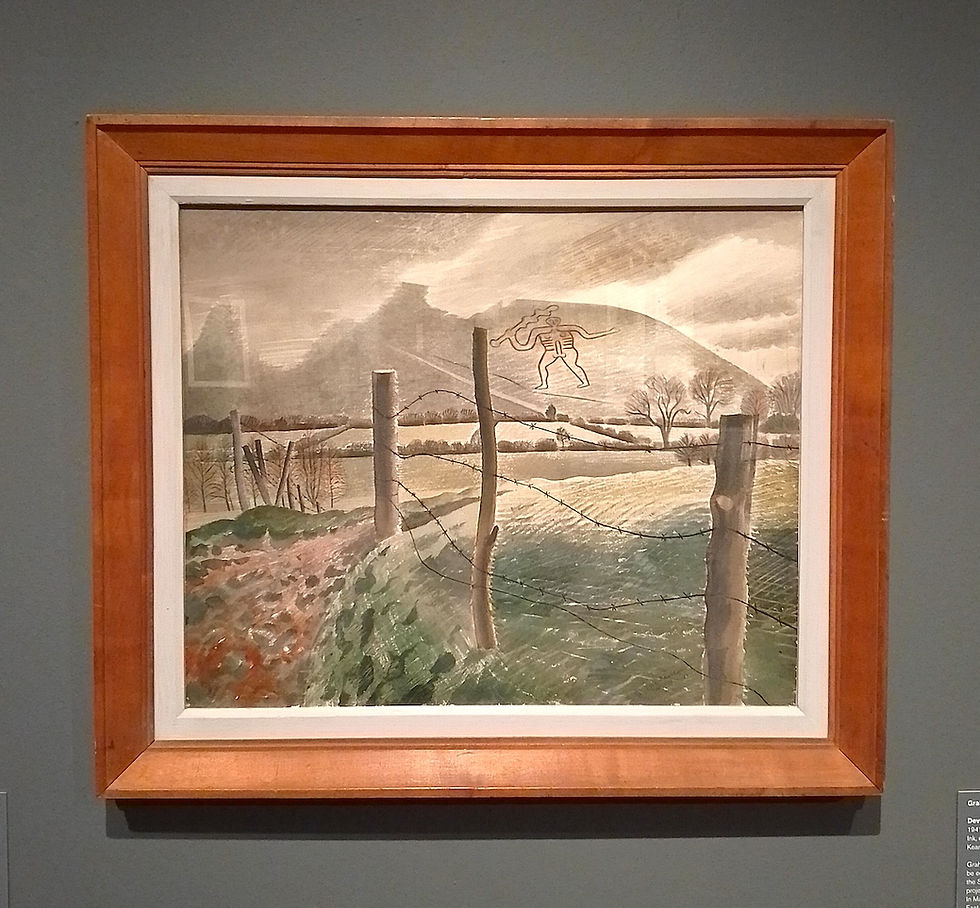
In Eric Ravilious’s painting of the Cerne Abbas Giant, we view the hillside chalk figure, as we do in his Wilmington Giant, at a distance through wire fencing.
With the recent popular re-emergence of all things folkloric within a particular strand of the British imagination, these enigmatic – can we call them grass etchings? – seem to encapsulate both the mystery of a not-quite-so-distant past and our own almost entirely post-rural viewpoint.
By post-rural, I mean the continued encroachment of modernity upon ways of living that once shaped our relationship with the countryside more directly. This was already a prominent theme for writers and artists in Ravilious’s time, and before him Palmer lived through the great transformations of the Industrial Revolution. Even the rural is no longer quite “rural” in the sense we once understood it.
No matter how wholehearted and genuine our efforts to imagine, engage with and reconnect to the people, lore and magical currents that created these figures, for us it is very often a matter of looking back. Modern antiquarian Julian Cope is fond of reminding us, with characteristic irreverence, that our distant ancestors were “forward thinking mofo’s!”
I visited Cerne Abbas for the first time only a few weeks before seeing the exhibition, so the locale was still fresh in my mind. When I walked into a village pub, conversation at the bar was already about whether a certain local person known to the regulars was, or was not “a copper.” As a stranger just come to town, the moment felt eerily reminiscent of The Wicker Man.
I visited Cerne Abbas for the first time just a few weeks before visiting this exhibition, so the locale was still fresh in my mind. When I walked into a village pub, conversation at the bar was (already) about whether a certain local person known to those regulars was, or was not, "a copper." As a stranger just come to town, this struck me as a moment eerily reminiscent of the Wicker Man.

Ivon Hitchens
Ivon Hitchens is an important artist to Pallant House, to Sussex, and to British art more generally. After his London studio was bombed during the Second World War, Hitchens and his wife moved to a location deep in the countryside on the northern side of the South Downs near Petworth.
His preferred format was often a canvas more than twice as wide as it was high. He associated this widescreen format with music, suggesting that we experience a painting more as we experience a landscape itself, attuning gradually to different elements that then cohere in the mind rather than taking everything in at once.

To begin with I was not especially interested in Hitchens’s work when I first encountered it a few years ago. As I came across it more frequently within the context of landscape art, and perhaps through my own connection to Sussex, I began to develop a deep appreciation for its richness and vibrancy.
The wide canvas might suggest a sweeping vista, but Hitchens lived within wooded heathland and rarely incorporated the nearby hills directly into his vision. Working outside, sometimes with the canvas very close to the ground, he would peer through layers of colour, texture and light, expressing the intricate beauty of a microcosm.
Rather than choosing a single view, there may be several possible ways into the painting, different paths for the eye to follow.
It is clear that this is a kind of writing, but there is no need (yet) to read it or make out exactly what it means. Instead you feel its resonance and breathe its air. It seems to shift in front of you as light shifts on water or leaves turn over in the wind. It has the first requirement of a work of art: it is alive.— Christopher Neve, Unquiet Landscape

Norman Ackroyd
The North to my South, Norman Ackroyd’s stark monochromatic prints evoke a longing for distant mountains and seas, so distinct from the heath and pond of Hitchens and the South Country more generally.
I attended a talk with Ackroyd at the Fine Art Society in Edinburgh, where he had a wonderful way of describing the process of making work through being within the landscape, or, very often in his case, the seascape.

In British Landscapes: A Sense of Place there is a grouping of six small prints by Ackroyd, whose presence provides perhaps the most striking contrast to much of the other work in the exhibition. Often drawn to outliers, islands and coasts that seem always to lie just off the edge of the map, his work takes us towards an extremity.
If we continue the idea of the gallery as a kind of ritual landscape in itself, Ackroyd’s station takes one beyond, outwards, in contrast to artists such as Palmer, Sutherland and Hitchens, whose work seems to draw us further into a hidden world. Sea and mountain open into distance where meadow, tree, cottage or church draw us towards intimacy.
In my own work the North has been a theme of longing and inspiration, in both a geographic and spiritual sense.
Landscape and the living imagination
Looking through the exhibition, I became increasingly aware that the artists whose work I return to most often are rarely concerned with landscape as topography alone. Palmer’s visionary pastoralism, Nash’s sacred geography, Hitchens’s immersion in the microcosm around him, Ackroyd’s remote edges, all approach landscape as something living and participatory.
I am less interested in landscape as scenery than as presence: places that seem to possess an atmosphere, life or intelligence of their own. Whether walking ancient sites, remote coastlines, woodland tracks or the South Downs, I am often seeking the moment when landscape becomes a living encounter.
The artists in this exhibition arrive at that threshold in very different ways, yet perhaps this is what connects them most strongly: landscape not merely observed, but entered into relationship with.
You can explore more of my landscape-inspired artwork on the main Art page.


Returning to British Landscapes: A Sense of Place
When I first visited the exhibition during quite a busy opening weekend, I became aware that there was undoubtedly work that I didn't give proper attention to. On my second visit it was interesting to discover artworks I hadn't previously noticed, or passed with only a glance, that suddenly became very prominent to my mind.
Gwenda Morgan
In the same room where I found the works by Palmer and Sutherland, placed by itself on a narrow sliver of wall at the entrance to the next gallery room was Fittleworth, a wood engraving on paper by Gwenda Morgan, which depicts the 11th century church in the village. It is a small yet striking piece, and conjures the atmosphere of a place dear to my heart, where a number of my favourite walks in Sussex begin. Kevis House Gallery in Petworth has a number of her works available.

Winifred Nicholson
The windswept and autumnal looking Cumberland Landscape by Winifred Nicholson, has a strong sense of immediacy and vigour in the painting. In his inspired book on British painting Unquiet Landscape, Christopher Neve describes Nicholson's approach to colour and light as implying she had..
..a strongly developed sense of the unseen, the belief that the essence of landscape was just out of sight beyond appearances; that, were her own faculties and beliefs more developed, she would see more, feel more.

Ceri Richards
Inside a display case I found a work I had not encountered at all during my previous visit. The Hand that Whirls the Waters In The Pool was an engrossing image by Ceri Richards. Placed near a Graham Sutherland painting with which it has a resonance, this beguiling lithograph quotes the Dylan Thomas poem The Force that through the Green Fuse Drives the Flower, showing a writhing and effulgent mass of organic forms, expressing both the blooming of life, and the skull shape of its remnants. The image appears truly organic, and brought to my mind these words of Carl Jung;
Life has always seemed to me like a plant that lives on its rhizome. Its true life is invisible, hidden in the rhizome. The part that appears above ground lasts only a single summer. Then it withers away an ephemeral apparition.


Barbara Hepworth | William Crozier
I can't claim that either of these works really do much for me individually, and during my first visit I didn't really spend any time with them. When returning I was really struck by how they work together, and when reading about Crozier and his relationship with the landscape of Essex, where he was 'entranced by the bleakness and brutality of the landscape', in the words of his biographer Katherine Crouan. She describes Crozier as approaching painting in such a way that it was 'more than seeing...it is seeing with an eye pre-set in peculiar focus, so that the painter is not seeing but re-inventing, making the apple or the landscape in the image of his own disappointment or eccentricity'.
This painting certainly evokes bleakness, and its title the vast mudflats that constitute the coastal edge of the county. I know nothing else of Crozier's work, so at this juncture I could be departing from the artists own sense of place, however it struck me that the 'landscape of dark revelation and unease' (Sarah Vitoria Turner) described by the image, title, and the sculpture with which is seems paired, is that conjured by J.A.Baker in The Peregrine.
Hepworth's hawk-eyed sculpture gazes upon the painting, seeing as a peregrine might the earth magnified thirty fold, woven into acutely distinguished parcels of land far from human comprehension. In his afterword Robert Macfarlane describes the book as 'a record of obsession.' Baker himself, with such intense focus upon the roving predator developed a singular vision, as myopia shortened his sight. So this sculpture and picture are like a talon sharp eye for vastness, as it hurtles toward a rapidly approaching ground. "Nothing is as beautifully, richly red as the sight of blood on snow. It is strange that the eye can love what mind and body hate," says Baker, with repulsion and delight.
In closing out his afterword, Macfarlane defers to Baker, and I wonder if this also speaks to landscape painting; if one can see it, why do anything at all with that experience?
The hardest thing of all to see is what is really there - (J.A.Baker)
British Landscapes: A Sense of Place, continues until 1st November 2027 at Pallant House Gallery, Chichester, Sussex.
My source of information and quotations (unless otherwise noted) is the exhibition catalogue by Simon Martin.


