


Alchemy and Mysticism in Art
Updated: Aug 10
Alchemical images have interested me for many years because they bring art, spiritual experience, and psychological transformation into the same field. Their vessels, furnaces, angels, skeletons, suns, and strange conjunctions give transformation a visible form and invite an encounter that cannot be resolved through explanation alone.
Alexander Roob’s Alchemy & Mysticism, published by Taschen, is one of the books through which I have most often returned to this imagery. Its pages bring together illuminated manuscripts, engravings, mystical cosmologies, alchemical diagrams, and visionary works by artists including Albrecht Dürer and William Blake.
What continues to draw me back is the sense that these images possess a life beyond the information they contain, acting upon the imagination before their meaning is consciously understood. This has close affinities with Jungian and post-Jungian ideas about psyche and image, with the use of dreams and artworks in psychotherapy, and with my own experience of art-making as a process whose direction is not always known in advance.

What is meant by alchemy here?
The word alchemy is now used very freely, referring to almost any process of creativity, healing, personal development, or change, while alchemist has become an appealing description for many kinds of practice. Used too broadly, the term can lose much of its particular meaning.
Here, I am referring to the historical alchemical traditions that developed through material experiment, philosophy, religion, mysticism, and visual culture. These traditions were themselves diverse: alchemy could involve the refinement and transformation of substances, including the search for the philosopher’s stone and the transmutation of base metals, while material processes could also be inseparable from spiritual purification, divine knowledge, or the transformation of the practitioner.
Later psychological readings, particularly those associated with Carl Jung, approached alchemical imagery as a language through which unconscious and transformative processes might be understood. Such interpretations do not exhaust the historical traditions, although they have become especially significant within depth psychology.
The images considered here belong to this richer cultural and spiritual field, and my interest lies in the way material, artistic, psychological, and mystical meanings gather within them.
The Opus as Image
What strikes me most in these pages is that, even where the material appears diagrammatic, something more than explanation is taking place, because the images participate in the processes they present.
The alchemical opus concerned the transformation of matter through dissolution, purification, recombination, and refinement, yet its visual language extends beyond a literal laboratory procedure. Vessels, furnaces, suns and moons, human figures, animals, angels, skeletons, and changing colours create a world in which physical, psychological, and spiritual transformation continually overlap.
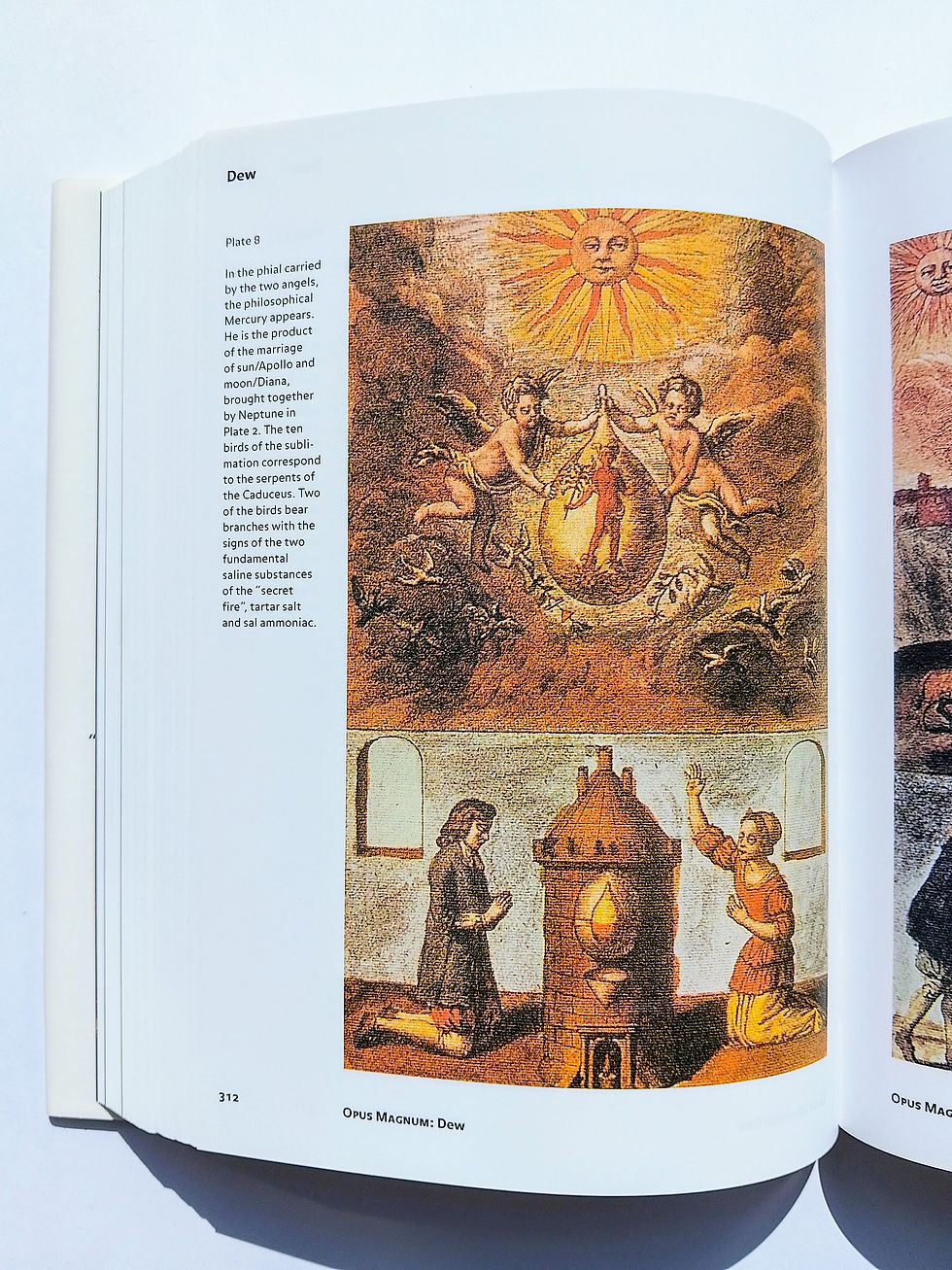
To approach the opus through imagery can itself feel like a form of participation, since the image gives transformation a presence that cannot be contained within a definition and allows material process, inner experience, spiritual aspiration, and mystery to remain in relationship.
This is part of what continues to draw me towards alchemical art: its images bring us into contact with transformation through its tensions, obscurities, and possibilities.
Albrecht Dürer and melancholy
Among the artists represented in the book, I return particularly to Albrecht Dürer, whose engravings combine extraordinary precision and beauty with a compelling psychological and spiritual density.
Melencolia I is perhaps the most familiar example. Its winged figure sits surrounded by tools, geometrical forms, instruments, and signs of knowledge, yet appears unable to act. The engraving has attracted innumerable interpretations, although much of its power lies in its resistance to being exhausted by them.
Melancholy here is connected with imagination, knowledge, creative power, limitation, and the burden of what has not yet found form. The figure seems suspended between capacity and paralysis, surrounded by the means of making while held within an atmosphere of incompletion.
The image remains alive because no single explanation resolves it, and different aspects become visible at different times according to what the viewer brings to the encounter.
William Blake and visionary imagination
William Blake matters to me in many respects because, throughout his work, poetry, visual art, spiritual vision, and artistic practice belong to one imaginative world.
His illuminated books bring word and image into a shared visionary activity in which thought, prophecy, myth, and visual form continually act upon one another. Blake’s work suggests that imagination can be a way of encountering reality rather than simply escaping from it, allowing artistic making to become a form of perception through which spiritual and psychological experience acquires presence.
This understanding has clear affinities with both mystical traditions and depth psychology, where imagination may carry knowledge of its own even when that knowledge remains symbolic, paradoxical, or resistant to literal explanation.
Splendor Solis and the primacy of image
The images of the Splendor Solis are among the most beautiful works in the alchemical tradition. Their luminous colours, elaborate settings, vessels, figures, and transformations draw the viewer into a world that feels simultaneously material and visionary.
Their importance lies in more than their ability to communicate alchemical ideas, because the image itself is primary, giving the transformative process a form before that process has been organised into an intellectual account.
This has close affinities with Jungian and post-Jungian understandings of psyche. Jung recognised that dreams and spontaneous images can carry unconscious meanings before the conscious mind has understood them, while Hillman placed even greater emphasis upon the imaginal nature of psyche itself. From this perspective, an image may be one of the primary ways psychological life becomes present.
Words can help us approach an image, although they should ultimately lead us back towards it, since interpretation becomes limiting when the explanation replaces the image and assumes that the encounter has been completed.
A similar principle applies in psychotherapy, where a dream, fantasy, remembered scene, or artwork may gather words around itself while retaining meanings that continue to unfold over time. The task is to remain in relationship with the image rather than translating it too quickly into a settled conclusion.
The black sun and transformation
Another image to which I am repeatedly drawn is the black sun.
In the page reproduced here, a skeleton appears against a darkened solar form. The conjunction of death and sun is profoundly paradoxical because the sun ordinarily evokes light, warmth, life, and consciousness, yet here those associations have entered a darker register.

Alchemical images of death, putrefaction, and darkness may belong to a larger transformative movement in which an existing form breaks down before another can emerge. This should not be converted into an easy promise that every period of darkness conceals an eventual benefit, since the image has greater seriousness than such reassurance allows, holding death, dissolution, uncertainty, and transformation together without pretending that their meaning is already known.
Stanton Marlan’s The Black Sun is one of the Jungian texts to which I have returned most often. His exploration of darkness resists treating it solely as pathology or as the temporary absence of light, allowing the black sun to become an image through which psychic darkness may possess its own depth and a paradoxical form of illumination.
I plan to look more closely at this book in a separate post.
Transformation as process
The recurring movements within alchemical imagery unfold through vessels, furnaces, changing substances, and bodily forms, presenting dissolution, death, recombination, and renewal as processes rather than abstract ideas.
Transformation involves endurance and uncertainty, and its outcome cannot be decided at the beginning because the process may alter an existing form beyond recognition.
This has clear resonances with creative practice, where making an artwork often involves following something before its final form is understood. Materials, accidents, revisions, and emerging images may lead the artist away from the original intention.
Art can become a site of transmutation through what is made and through what happens within the maker. Mysticism and alchemy have been present within my own work from its beginnings, though their influence is more deeply embedded than any direct illustration of occult concepts. Image-making can become a form of enquiry in which material, psychological, spiritual, and imaginal experience enter into relation.
Alchemy and the therapeutic relationship
Jung’s engagement with alchemy was closely connected with his understanding of psychological transformation and of the relationship between analyst and patient.
Psychotherapy takes place through a shared process between two people whose roles and responsibilities remain different, and something may develop within the relationship that cannot be attributed entirely to either individual.
The alchemical vessel offers a powerful image for this because it contains a process while allowing heat, tension, separation, and recombination to occur. In a similar way, the therapeutic relationship requires boundaries and continuity capable of holding experiences that may initially feel confused, contradictory, or difficult to articulate.
The comparison should not be applied too rigidly, since psychotherapy does not follow a predetermined sequence of alchemical stages. Alchemy instead offers a language of images through which transformation can be approached without reducing it to a technique or guaranteed outcome.
In depth-oriented work, dreams, fantasies, remembered scenes, and artworks can be returned to repeatedly, with their significance developing through the person’s relationship with the image, the therapist, and the changing circumstances of their life.
Staying with the image
One of the most important lessons I take from alchemical art is the need to remain with an image rather than allowing explanation to bring the encounter to a premature end.
We may decide that a skeleton signifies death, a sun signifies consciousness, or a vessel signifies containment, and thereby overlook the particular life of the image before us. Remaining with an image involves allowing it to retain some otherness, since it may affect us before we understand why, while certain features become visible gradually and meanings that initially seemed secure begin to change.
This is true in art, psychotherapy, and spiritual life, where words can deepen the encounter when they return us to what is present rather than taking its place.
Books such as Alchemy & Mysticism remind me that images can carry knowledge in ways that are not immediately apparent, giving shape to mystery, contradiction, and transformation without resolving them.

We Are Ajar To The Night
My ink and pastel work We Are Ajar to the Night occupies related territory, with a central mountain emerging between darkness and light to create an atmosphere of threshold and transition.
The title comes from Autumn Richardson’s Ajar to the Night, a work of devotional poetry published by Scarlet Imprint. I was drawn to the phrase because it suggests an openness to what becomes perceptible in darkness: the imaginal, the spiritual, and what is not yet consciously known.
Although the artwork does not represent a particular alchemical stage, its mountain, divided atmosphere, and movement between obscurity and illumination belong to the wider field of concerns that draws me towards alchemical imagery. For me, the significance of such images lies less in what they can be made to explain than in the worlds they allow us to enter.
Further connections
Alchemy, mysticism, art, and depth psychology meet through their attention to transformation and to forms of knowing that exceed literal explanation.
These concerns also inform my work as a visual artist and psychotherapist. My art explores landscape, the numinous, and our relationship with the living world, while my therapeutic practice is informed by depth psychology and by an understanding of image and imagination as meaningful expressions of psychological life.
A related reflection can be found in my post on The Philosopher’s Secret Fire: A History of the Imagination.


