


The Black Sun: Darkness, Art, and the Light of Nature

Updated: Aug 28
The Black Sun has been part of my imaginative and spiritual landscape for many years, shaping how I think about nature, darkness, inner life and the unseen dimensions of experience. These concerns have also found expression within my artwork, sometimes explicitly and sometimes in more concealed ways. At times the Black Sun has appeared as a dark solar form suspended above a mountain or landscape, but more often, particularly in recent years, its presence has become less emblematic and more diffused, entering the darkness of the landscape itself, colour, material and the possibility of a light that seems to arise from within nature.

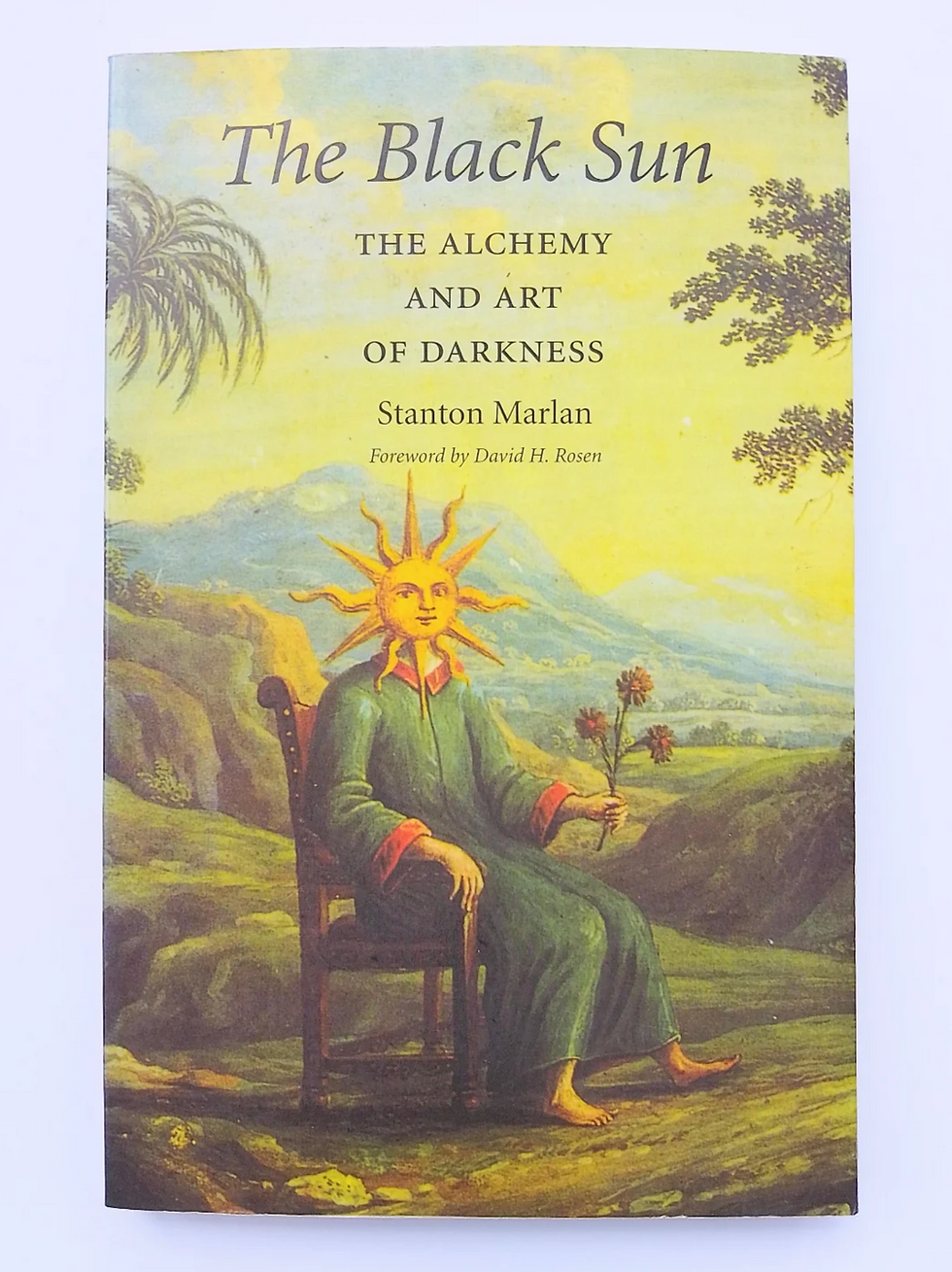
Stanton Marlan’s The Black Sun: The Alchemy and Art of Darkness has become an important book for thinking about this territory. Marlan is a Jungian analyst, and although the book ranges far beyond what is often presented today as conventionally “Jungian”, to me this breadth feels closer to Jung’s own mode of enquiry, in which psychology, alchemy, religion, art, myth and metaphysics were never neatly separated. Marlan follows the Black Sun in a similarly expansive way, towards questions of mortality, psychic destruction, beauty, nothingness and the limits of the Self.
At one point he writes:
“It is not my goal to lead anyone beyond the darkness but instead to the illumination of darkness itself.”
I find that distinction important because darkness is not simply an obstacle on the way towards some brighter psychological or spiritual condition. Marlan asks what becomes perceptible when darkness is allowed to retain its own depth.
A darkness that shines
The Black Sun is closely associated with the alchemical nigredo. In alchemy, nigredo is the blackening, a condition of decomposition, dissolution and the breaking apart of established form.
Psychologically, it can describe periods when familiar structures of identity and meaning cease to hold: a way of living may collapse, an old understanding of oneself may lose its authority, or something long avoided may begin to demand attention. Grief, depression, crisis and major transition can all carry something of this quality, although none can simply be equated with nigredo.
The alchemical work begins with the prima materia, the elusive first matter upon which transformation takes place. Descriptions of it vary greatly. It can appear base, rejected or undifferentiated while also carrying within it the possibility of transformation, and the nigredo strips away familiar form until the alchemist is brought into contact with something that cannot yet be clearly separated, named or understood.
It is tempting to turn this into a linear psychological story in which nigredo is followed by later stages of clarification until one finally arrives at the rubedo, the reddening associated with completion. The alchemical processes are more fluid than this, and different movements may be taking place at once: one part of life may be dissolving while another is becoming more differentiated, something may be dying while elsewhere something has already begun to take form, and the whole process may circle back, repeat or alter in scale.
This matters because the Black Sun is too easily reduced to the dark stage before the light. Marlan’s treatment is less orderly, allowing for the possibility that darkness may already contain something that the usual opposition between darkness and illumination prevents us from perceiving.
Jung repeatedly returned to this problem. In Modern Man in Search of a Soul he writes:
“The psychic depths are nature, and nature is creative life. It is true that nature tears down what she has herself built up—yet she builds it once again... At first we cannot see beyond the path that leads downward to dark and hateful things—but no light or beauty will ever come from the man who cannot bear this sight. Light is always born of darkness...”
There is renewal here, but very little sentimentality. Nature does not exist simply to protect us from destruction, and Jung does not suggest that the path downward can be bypassed because we already know where it ought to lead.
The image of descent is ancient. The Greek katabasis names a going down, often into the underworld, and the pattern appears in figures such as Persephone and Orpheus as well as in older traditions of dream incubation, where healing could be sought through darkness, sleep, enclosure and withdrawal from ordinary consciousness.
Peter Kingsley has repeatedly returned to this forgotten dimension of healing, particularly in his discussions of dream incubation and the ancient Greek traditions from which philosophy partly emerged. His deliberately provocative remark, “if you are looking for healing in the light, God help you”, which stayed with me from an audio recording, points towards something easily lost in contemporary spiritual language, where healing is so often imagined as ascent, brightness or escape from darkness. Older traditions sometimes understood it as requiring a descent towards what ordinary consciousness would rather avoid.
This does not sanctify suffering; it suggests that healing may at times require a descent into what cannot be resolved from the position one already occupies. Marlan asks a related question when he considers what it might mean for darkness itself to possess a form of illumination.
Lumen naturae
One of the central ideas running through The Black Sun is the lumen naturae, the light of nature.
Marlan describes it as a different kind of light, one that “shines at the core of matter” and belongs to ancient alchemical ideas of the subtle or illuminated body. Elsewhere he writes:
“The lumen naturae is an image of light at the core of ancient alchemical ideas. One of the aims of alchemy was to beget this light hidden in nature, a light very different from the Western association of light as separate from darkness.”
He then turns to Jung’s description of the lumen naturae as:
“the light of darkness itself, which illuminates its own darkness.”
This is considerably stranger than the familiar idea of finding something positive during a dark period, because the light is already present within the darkness and belongs to its nature.
In his essay “From the Black Sun to the Philosophers’ Stone”, Marlan develops this further by describing the Philosophers’ Stone as linked to the lumen naturae of the Sol niger, a luminous vehicle and one of the central mysteries of alchemy. The work involves a death of the ego, yet the shining that emerges was already present “at the core of darkness”, and Marlan is wary even of understanding this simply as a positive outcome, suggesting instead that the image may require a liquefaction or displacement of the position from which the self ordinarily understands itself.
The Sol niger and lumen naturae meet closely in Marlan’s exploration while retaining different emphases. The Black Sun carries a wider symbolic field, whereas lumen naturae describes something more particular: a luminosity belonging to nature and matter, including a darkness capable of illuminating itself.
This requires careful qualification. To speak of “a darkness that shines” is not to suggest that cruelty, torture, war, trauma or other forms of suffering are good, beautiful, sacred or spiritually illuminating, and suffering does not acquire value simply because it can be placed within an alchemical, psychological or spiritual narrative. The symbolic association of the Black Sun with destruction, death or psychic extremity should never turn those realities into occasions for spiritual romanticism. Marlan’s willingness to remain with them matters partly because he does not have to redeem them immediately.
Blackness without consolation
The nigredo has become an attractive metaphor within contemporary psychological and spiritual writing, often condensed into a familiar sequence in which something falls apart, we descend and eventually emerge transformed.
Human experience can sometimes resemble this. Psychotherapy often begins when established ways of living no longer hold, perhaps because a relationship ends, a structure of identity fails, or life becomes impossible to continue in quite the same way. Yet a ready-made story of transformation can itself become a defence against what is actually happening.
Marlan describes facing his own concerns about mortality and finding that this eventually opened towards a greater gratitude and wonder in relation to life. Mortality is not defeated in this movement; the encounter alters his relationship to living without cancelling death.
He also questions the assumption, familiar in psychotherapy, that when something has become deeply troubling our first task must be to discover what has “gone wrong”, because that question already presumes a right version of life from which the person has somehow deviated.
Marlan writes:
“What is not seen by the wounded soul is that what is happening under the surface...is a dying of immature innocence...which holds a transformative possibility.”
The word possibility is important because there is no guarantee that suffering will lead to wisdom or that every loss belongs to some larger process of necessary development. Marlan is most interesting when he resists precisely this kind of consoling linearity.
The burden of the Black Sun
The Black Sun also carries a modern historical burden that cannot simply be avoided.
The particular twelve-rayed design at Wewelsburg Castle, created during its reconstruction under the SS, is now widely known as the Black Sun and has subsequently been adopted within neo-Nazi and far-right contexts. The familiar name and much of the occult mythology later attached to that particular design arose after the Nazi period, but its contemporary associations are now part of the symbolic territory.
Eva Kingsepp addresses this in her introductory essay to Liber Nigri Solis, a contemporary occult grimoire devoted to the Black Sun. She observes that the image has often been used without serious attempts to define it, “as if its presence in itself invokes a mystery that lies beyond the describable”, and describes a recurring sense of the Black Sun as an other sun, distinguished from the ordinary or “vulgar” sun and associated with negativity and otherness.
Elsewhere she notes that, across its different histories, the Black Sun has been connected both with what is regarded as profoundly negative and with what has been experienced as strangely beautiful or divine. Her observation is valuable because it shows how radically different meanings can gather around the same image without becoming equivalent, while also recognising that anyone working seriously with a symbol of otherness has to reckon with the histories that have accumulated around it.
At the same time, twentieth-century ideological appropriation cannot retrospectively claim every darkened sun appearing in alchemy, mysticism, art or religious imagination. The Sol niger explored by Marlan belongs to a much older and wider field, and although that difficult modern history deserves attention in its own right, it is not the principal subject I am pursuing here.
An occult counterpoint
The Black Sun also persists within contemporary magical and occult traditions in ways that complicate Marlan’s account.
In Avalon Working: A Landscape Grimoire, Mark Nemglan develops the idea of a hidden solar power within a wider initiatory cosmology involving Sirius, the underworld of Annwn and the mythic geography of Avalon. Earlier in the book he describes Sirius as the “sun behind the sun”; later, in his more concentrated discussion of the Sol Niger, he identifies the hidden sun specifically with Sirius B.
By the “lower regions”, Nemglan is referring to an underworld or chthonic realm: Annwn, the hidden world beneath or behind ordinary manifestation, populated in Welsh tradition by the tylwyth teg and associated in his system with death, initiation and concealed spiritual realities.
He writes:
“The Black Sun exposes that which is hidden, suppressed and buried.”
Nemglan also speaks of lumen naturae as “the light within the darkness”, developing the idea within a more explicitly initiatory and magical framework.
One of his more interesting distinctions concerns Saturn. Nemglan resists simply treating Saturn and the Black Sun as equivalent, arguing that Saturn imparts its harsh lessons through the terrestrial sun and that pain, destruction and the horrors of human life already occur within the manifested world. The point becomes especially clear when he observes that war and atrocity happen beneath the full glare of the midday sun.
Some of the most horrifying things human beings do are planned in offices, written into policy, documented, administered and carried out through ordinary systems. They take place in daylight, and part of their horror lies in how organised, procedural and mundane they can be. Light and darkness therefore cannot carry our moral distinctions for us.
Nemglan’s Black Sun is a concealed luminosity, the “sun behind the sun”, belonging to another order of reality, whereas Marlan allows the Sol niger to remain more thoroughly entangled with mortality, melancholy and psychic devastation. Their differences show how unsettled the symbol remains even within contemporary esoteric thought.
Imaginal darkness
Henry Corbin approaches neighbouring territory from a very different spiritual and philosophical tradition.
In The Man of Light in Iranian Sufism, Corbin writes of black light, the midnight sun and the light of the cosmic North. His wider work recovers the mundus imaginalis, an intermediate and intermediary reality between spirit and matter.
Writing about Corbin’s research into the imaginative science of Sufi mystics, Veronica Goodchild describes this as a “lost continent”, an ontologically real subtle world approached through what she calls true imagination. Across different traditions, such intermediary or imaginal worlds have been known under many names, including Corbin’s Eighth Climate and Na-Koja-Abad, the “country of non-where”, as well as other mythic and spiritual topographies.
These belong to different traditions from the Sol niger and lumen naturae, though they touch a related question: whether imagination may sometimes be a way of perceiving rather than merely inventing, and whether reality can include dimensions that do not fit comfortably into the division between an objective external world and a subjective inner one.
This has considerable relevance to art, where an image may belong to both worlds without being reducible to either.
The Black Sun in my own work
The Black Sun has appeared explicitly in my artwork only a handful of times.
Nightside (top of this article), made in 2015, shows a dark mountain beneath a turquoise sky, with a charcoal-black sun suspended above it. A related work, Uncontainable Night, belongs to the same period, although its atmosphere is transformed by a radiant pink-red sky. In both, the Black Sun is clearly present as an image.

Another work from around the same period, The Mountain of Light, already begins to shift the relationship. There is no black sun. A dense black mountain sits among deep blues and whites, while the light appears to come from the mountain itself.
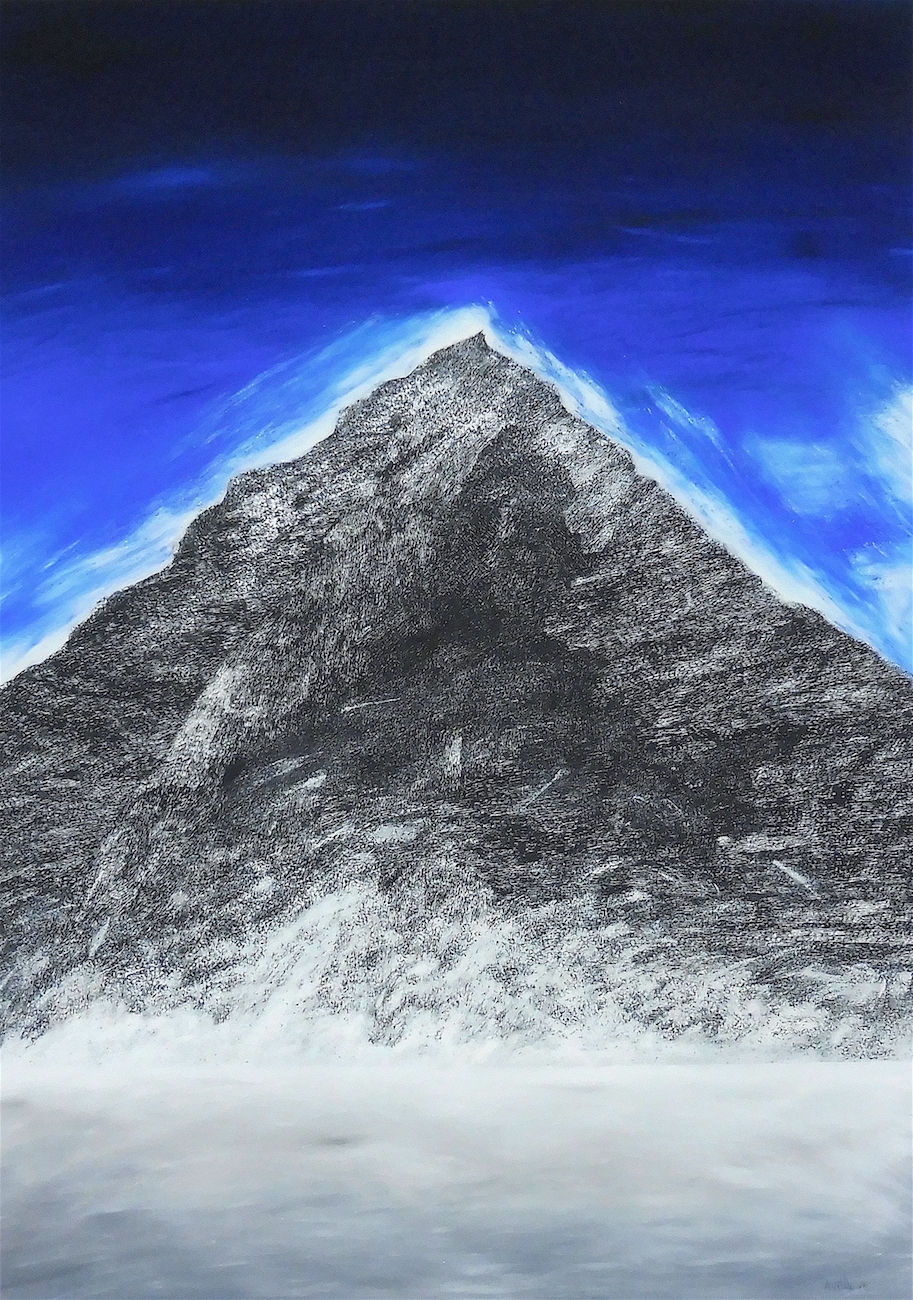
Over the years that followed, the explicit Black Sun largely disappeared from the work while darkness moved into the landscape itself, into mountain, ground, sea and atmosphere. Some of the pastel and ink works became physically very dark, while elsewhere, particularly in painting, colour became increasingly luminous.
In The Return (2025), a dark mountain rises amid what might be read as stormy seas. Black paste occupies the upper sky and the lower ground or water, while carborundum scattered lightly across the surface catches the light and creates a subtle glistening effect. The title carries a quiet Saturnian association, though that is not something a viewer needs to know in order to encounter the painting as, on the face of it, a landscape.

I value that openness, and do not want the images to function only as illustrations of occult ideas, nor should someone need to recognise an alchemical or esoteric reference before they can connect with the work. At the same time, I feel less need now to obscure the wider spiritual and metaphysical field from which the artowrks emerge. It is there for those who recognise it, while remaining unobtrusive for those who encounter the work differently.
These associations are not a recent interpretative layer added to older paintings. Writing about my work in 2016, Keith Hackwood identified the Black Sun as a recurring image and placed works such as Nightside within a wider field of alchemy, embodied imagination and Anima Mundi. His essay The North Remembers is an account of this earlier period.
Marlan himself discusses artists who have approached related territory and places Anselm Kiefer within the alchemical context of the lumen naturae, “the dark light of nature”. Kiefer has been an important influence on my work for many years, and I have written elsewhere about encountering his early work and the force with which earth, matter, decay and transformation remain embodied in it rather than becoming illustrations of abstract ideas.
Darkness within matter
What interests me now is where this current has moved as the explicit symbol has become less frequent. The darkness that once appeared in the sky has increasingly entered the substance and atmosphere of the landscape, while in other works, some of them very bright, colour has moved towards an intense internal luminosity.
This is where lumen naturae comes much closer to describing what has persisted than the Black Sun itself.
I have become increasingly interested in the possibility that landscape might appear illuminated from within, in something closer to matter seeming to contain its own light than to illumination as an obvious metaphor or dramatic effect. Mountains can become almost gemlike, dense and physical while containing colour that opens into other depths, worlds within worlds.
This is also part of what has drawn me towards oil paint. Acrylic has allowed me to approach much of this through layering and colour, but I increasingly want a different depth of luminosity within the paint itself, and the transparency, opacity and slow accumulation possible in oil offer another way of approaching the tension between material density and light.
I have yet to resolve this in finished oil paintings, which feels appropriate because the material itself has become part of the enquiry.
The light of nature
The phrase lumen naturae can sound remote from ordinary experience, yet the questions it raises are immediate. What does it mean to experience nature as possessing an interiority of its own, what role does imagination play in such an experience, and is the distinction between perception and projection always as simple as it first appears?
These questions have accompanied me for much longer than I have had adequate language for them. Landscape has never interested me only as scenery, nor are the paintings primarily concerned with recording particular places; mountains, hills, mounds, seas and horizons recur as forms through which a relationship with the world can be imagined and felt.
The alchemical language of lumen naturae offers one way of approaching this relationship without defining it completely.
There is a parallel here with psychotherapy, although art and psychotherapy remain different practices, because both can involve staying with an image or experience before deciding too quickly what it means.
James Hillman makes a related argument in The Dream and the Underworld. The dream belongs to a nightworld, and something is lost when it is immediately hauled into the hard illumination of day-consciousness, dissected and translated into familiar psychological language. To approach the dream on its own terms requires something of the opposite movement: going towards the world in which it belongs.
That feels particularly relevant to the Black Sun. As an other sun, it may require another attitude of perception, one in which we remain for a while with the kind of world in which such an impossible image can exist rather than immediately dragging it into ordinary daylight and asking what it stands for.
The same can sometimes be true in psychotherapy. An image, dream or feeling may need repeated attention before its significance begins to unfold, and an explanation that arrives too quickly can tell us more about the habits of daylight consciousness than about the image itself.
Art allows a similar ambiguity. A painting can sustain meanings that neither artist nor viewer can finally translate into language while still being encountered directly and sensuously.
Perhaps this is one reason the Black Sun has endured. In her essay for Liber Nigri Solis, Kingsepp suggests that its presence can itself evoke a mystery beyond description. Marlan approaches it through psychology and alchemy, Nemglan through contemporary magical initiation, while Corbin leads towards other forms of hidden illumination; none finally closes the image.
Beyond the Self
Towards the end of The Black Sun, Marlan takes the enquiry into especially challenging territory.
For much of the book, the Black Sun can still be understood within a broadly Jungian account of the Self, in which darkness and light belong to a greater psychic totality, but Marlan eventually begins to question whether even this is sufficient.
He turns towards what he calls the non-Self, approaching what remains beyond representation, integration and the familiar aspiration towards wholeness. The Black Sun begins to disturb the assumption that psychic development culminates in an increasingly complete or illuminated Self.
This is one reason I regard Marlan’s work as considerably more radical than an invitation to “embrace the shadow”. The Black Sun may bring us towards the limits of the fantasy of completion itself.
Psychology here begins to touch negative theology and metaphysics, because the question is no longer only what an image means to an individual psyche, but what becomes possible when the individual psyche is no longer treated as the measure of everything encountered.
There is something deeply human in the desire to make experience meaningful and gather its fragments into a coherent story, yet the world retains an excess that cannot finally be gathered into us.
I no longer feel particularly compelled to paint the Black Sun itself. What remains is harder to represent directly: darkness within matter, luminosity within darkness, the interior light of landscape, and the intuition that nature possesses depths that do not depend upon human consciousness for their existence.
The Black Sun gives these concerns an unusually rigorous and uncompromising form. It neither asks us to celebrate darkness nor promises that suffering will be redeemed, but asks whether illumination must always mean leaving darkness behind.
The lumen naturae offers another possibility: a light belonging to nature and, in Jung’s remarkable phrase, to “the darkness itself”.
Further Reading
Stanton Marlan, The Black Sun: The Alchemy and Art of Darkness
The central inspiration for this essay, exploring the Black Sun through analytical psychology, alchemy, art and the relation between darkness and illumination.
C. G. Jung, Alchemical Studies
An important source for Jung’s engagement with alchemy and the lumen naturae, including his understanding of the light of nature as a light belonging to darkness itself.
Stanton Marlan, “From the Black Sun to the Philosophers’ Stone”, Spring, Issue 74
A further development of Marlan’s thinking around the Sol niger, lumen naturae, ego death and the Philosophers’ Stone.
Henry Corbin, The Man of Light in Iranian Sufism
An exploration of spiritual light, darkness, the cosmic North and imaginal geography within Iranian Sufi traditions.
Mark Nemglan, Avalon Working: A Landscape Grimoire
A contemporary initiatory and magical work within which the Sol Niger, lumen naturae, Sirius, Annwn and related alchemical and mythic images appear in relation to a wider ritual, landscape and metaphysical system.
Victor Voronov, ed., Liber Nigri Solis
A contemporary occult grimoire devoted to the Black Sun. Eva Kingsepp’s introductory essay is particularly useful for its discussion of the symbol’s ambiguity, otherness and complicated modern history.


